
Performance-based fire safety solutions for complex built environments.
Full in-house fire engineering, surveying and consultancy capability.
Osborn Associates has dedicated fire engineering and fire surveying teams with extensive experience across residential, education, manufacturing, healthcare, commercial, industrial and transport sectors.
Our fire engineering approach goes beyond compliance. We deliver performance-based solutions that support complex architectural design, optimise building safety and provide clear technical justification for review by building control bodies and approving authorities.
Three integrated disciplines within fire safety.
Fire Engineering - Projects
Performance-based fire engineering supporting complex building design from concept through to completion. We produce fire strategies, negotiate code approval and provide technical oversight during construction.
Fire Engineering - Consultancy
Specialist technical consultancy including CFD modelling, heat transfer analysis, structural fire assessments and forensic fire investigation. We provide expert support for complex regulatory and compliance challenges.
Fire Surveying
Comprehensive fire surveying services including external wall assessments (EWS1 and FRAEW), fire risk assessments, fire door surveys, firestopping inspections and construction stage compliance oversight.
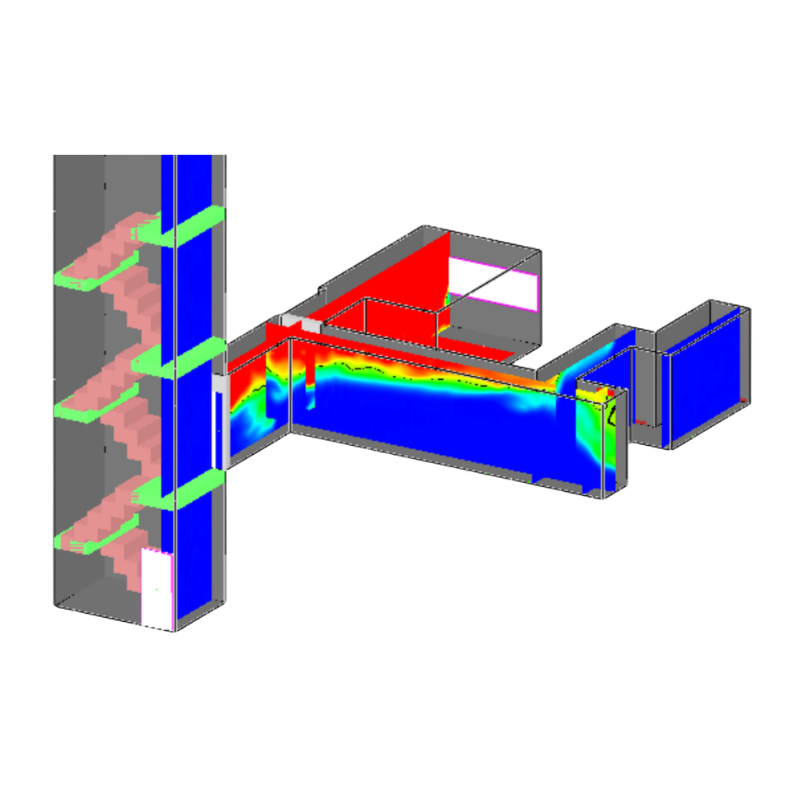
CFD Smoke Modelling
Our fire engineering team is fully trained and experienced in CFD modelling techniques, using globally recognised software to simulate a range of fire safety scenarios.
We use these simulations to inform fire strategy development, validate smoke ventilation designs and support building code approval with clear, evidence-based technical reporting.
Fire engineering across every building type.
Fire engineering FAQs.
A fire engineer is typically required when a building design departs from the standard guidance in Approved Document B, when the building is complex or high-risk, or when you want to explore performance-based design solutions that could reduce cost or improve architectural flexibility. Fire engineers are also appointed for change-of-use projects, heritage buildings and high-rise residential developments.
Fire engineering is the consultancy discipline that develops fire strategies, carries out risk assessments and produces CFD modelling to demonstrate how a building will perform in a fire. Fire protection engineering is the systems design discipline - designing the physical sprinkler, suppression, detection and alarm systems that deliver the protection specified in the fire strategy.
A fire strategy is a document that sets out how a building's design will protect its occupants and the building itself in the event of a fire. It covers means of escape, fire detection and alarm, structural fire resistance, compartmentation, access for the fire service and any fire suppression systems. It forms part of the building regulations submission.
Computational Fluid Dynamics (CFD) modelling simulates the behaviour of smoke and heat within a building during a fire. It allows fire engineers to predict how quickly smoke will spread, where it will accumulate, and whether proposed smoke ventilation or detection systems will provide adequate protection. It is used to justify performance-based design approaches.
Yes. We have delivered fire engineering projects across 14 countries including the Middle East, Europe, Asia and New Zealand. Our team is experienced in working to international fire codes and local regulatory frameworks alongside UK standards.
Yes. We regularly work on existing buildings for change-of-use projects, refurbishments, fire risk assessment reviews and remediation works. Our surveying team can assess the current fire safety provisions and our fire engineers can develop strategies to bring the building up to current standards or address specific compliance gaps.
What our clients say.
"The teams at Osborns are committed, professional, and above all, take the time to understand the client and business. Osborn Associates is very much my go-to consultancy."
Cliff Hutton
Construction Programme Director - Oasis Group
"Osborn Associates were both professional and flexible in their approach to the project and worked well with the design team to provide a timely solution."
Carl Varnam
Associate - Hydrock
"We have an extremely good working relationship and have found all of Osborn Associates as a company extremely customer-focused, cooperative and responsive."
Simon Cooke
Fire Safety Manager - University College London
